
The Origin of Ikebana Vases: A Complete History
Ikebana is one of the oldest living art forms in the world. But most people who own an ikebana vase don't know where it actually came from, or why it looks the way it does. This is that story.
It Started as a Religious Offering, Not an Art Form
Ikebana began in Japan around the 6th century, when Buddhism arrived from China and Korea. Monks placed cut flowers at altars as offerings to the dead and to the Buddha. There was no thought given to aesthetics. The vase was simply whatever vessel held water near the altar, usually a clay pot or a bronze container already used in temple rituals.
The word ikebana itself comes from "ikeru" (to arrange, or to give life) and "hana" (flowers). At this stage, the act was purely devotional. Flowers were placed upright, facing the altar. That single idea, that flowers carry meaning beyond their appearance, is where everything else began.
The Heian Period: Flowers Enter the Home (794 to 1185)
As Japanese court culture developed, flower offerings moved out of temples and into aristocratic homes. The Heian period was defined by refinement in art, poetry, and design. Nobles began arranging flowers in bronze and lacquered containers as a form of cultural expression.
This is when the vessel started to matter as an object in its own right. The container was chosen to complement the flowers, not just hold them. That shift in thinking, that the vase and the arrangement are one composition, is still the foundation of ikebana today.
Rikka: The First Formal Style (1400s)
By the 15th century, Buddhist monks at the Ikenobo school in Kyoto had developed Rikka, which means "standing flowers." This was the first codified style of ikebana. Arrangements were tall, complex, and designed to represent natural landscapes, mountains, rivers, trees, and open sky.
The vases used for Rikka were tall-necked and heavy, usually bronze or ceramic. The narrow neck controlled where stems could go, since there was no kenzan yet. Stems were propped and angled using a technique called kubari, where small forked twigs were wedged inside the vessel to hold everything in place.
The Kenzan Changes the Vase Forever (Edo Period, 1603 to 1868)
The kenzan, the metal spike disc that sits at the base of an ikebana vase, was invented during the Edo period. This is the single most important development in the history of ikebana vases.
Before the kenzan, vase shapes were limited by the need to prop stems using the vessel's own walls. The kenzan removed that limitation entirely. Stems could now be placed at any angle, individually, with precision. This opened up a completely new category of vessel: low, wide, and shallow. Potters and metalworkers began making suiban (flat trays) and shallow bowls specifically designed to hold a kenzan at the base.
Moribana: The Style That Made Low Vases Standard (Late 1800s)
In 1895, Ohara Unshin founded the Ohara school and introduced Moribana, which translates to "piled flowers." It was a deliberate rejection of the tall, formal Rikka style. Moribana arrangements sat low, spread outward, and used the kenzan in a shallow tray to create compositions that looked like natural landscapes viewed from above.
This style is why the low ikebana vase exists as a standard form today. The wide, flat vessel with a visible kenzan that you see in modern homes, including the BYAAS Anaar Bloom, is a direct line from Ohara's Moribana.
The Three Schools and What They Contributed
Three schools have shaped ikebana across the centuries. Ikenobo, the oldest, established the principles of structured composition. Ohara introduced the low vessel and made ikebana accessible outside temple and court settings. Sogetsu, founded by Sofu Teshigahara in 1927, went furthest of all: declaring that any container could be an ikebana vessel, regardless of material or tradition.
That Sogetsu philosophy is what makes a brushed brass or chrome vessel entirely legitimate as an ikebana vase. The material is modern. The intention is the same.
Why the Vase Shape Looks the Way It Does
Every design decision in a modern ikebana vase has a historical reason behind it. The low profile comes from Moribana. The wide opening comes from the kenzan's need for space. The clear or simple exterior comes from the Sogetsu principle that the vessel should not compete with the arrangement.
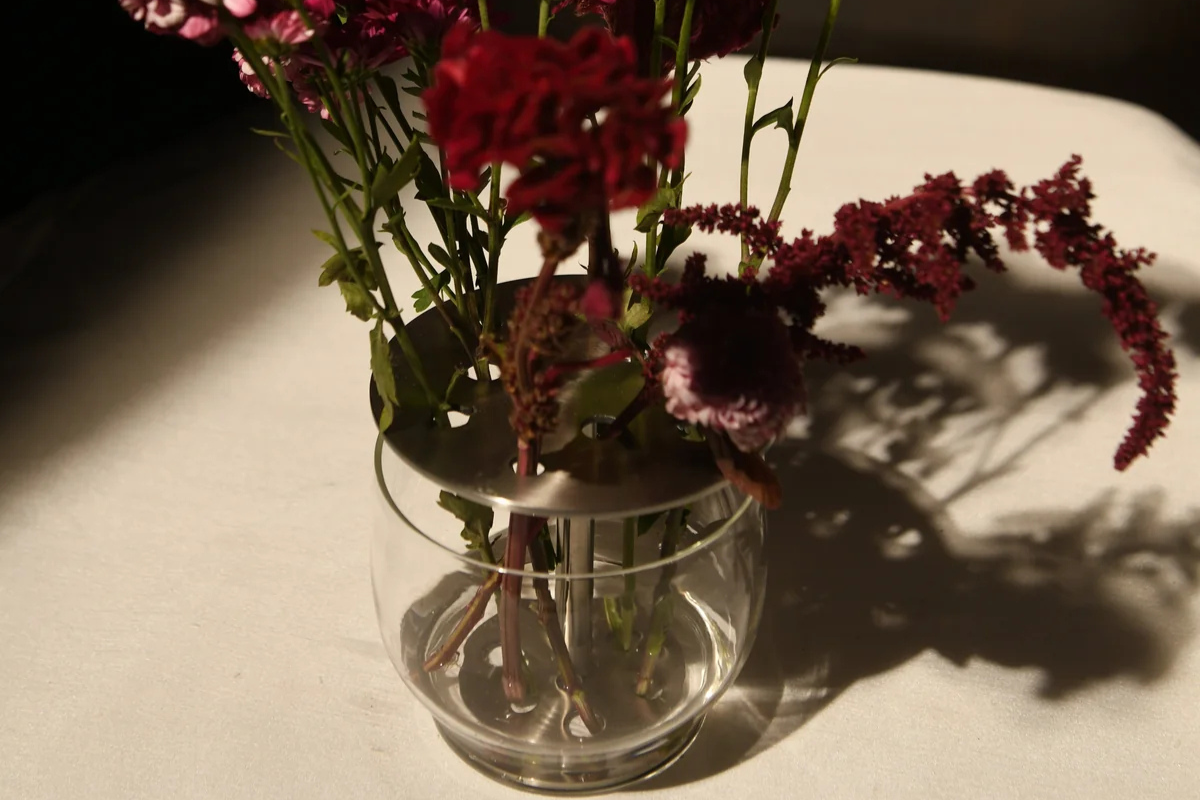
The BYAAS Anaar Bloom pairs a clear glass vessel with a sculptural metal kenzan. The glass keeps the focus on the flowers. The metal kenzan reflects the 70-year heritage of metal craftsmanship that BYAAS is built on. The Anaar motif, a pomegranate reference rooted in Indian craft tradition, adds a layer of cultural meaning that connects two entirely different heritages through one object.
The Art Form Is Still Alive
Ikebana has over 3,000 schools operating worldwide today. It is practiced in Japan, the United States, Europe, and increasingly across South and Southeast Asia. The vase has evolved from a clay temple pot to a hand-beaten brass vessel, but the core principle has not changed in fifteen centuries: the container and the flowers are one composition, and every element inside it is placed with intention.
When you use an ikebana vase, you are working within a tradition that is 1,500 years old. That is worth knowing.

Written by Bhavini Khullar