
Hand-Beaten Brass: How Byaas Artisans Shape, Finish and Inspect Every Piece
By Bhavini Khullar | Founder, Byaas | Adjunct Professor, Montclair State University
Short answer: Hand-beaten brass is shaped with hammers rather than only by machine. At Byaas each piece is drawn, shaped, welded, finished and inspected by hand, which is why small hammer marks are a signature, not a flaw.
A hydraulic press can stamp a brass candle holder in a few seconds. Our Tree of Life wall panel takes days. Same metal, same workshop. The difference is not efficiency. It is my intention.
I wrote this post because the word "handmade" has been stretched so thin online that it barely means anything anymore. You deserve to know exactly what happens to a sheet of brass between our drawing board and your dining table, and why the small hammer marks you see on a Byaas piece are a signature, not a flaw.
First, what is brass?
Brass is an alloy of copper and zinc. It is strong enough to hold a shape for generations, soft enough to be worked by hand, and it develops a warm patina over time. It has been used for lamps, vessels and ornaments for thousands of years for exactly those reasons. Hand-beaten brass is brass that has been shaped, in whole or in part, with hammers rather than only by machine.
Step one: the drawing and the pattern
Every piece starts on paper. For a candle holder that means the profile, the cup diameter and the base footprint. For a repoussé panel it means the full composition, drawn at actual size. We then cut a template so the form can be repeated accurately. Our post on how drawings become products covers this stage in detail.
Step two: shaping the metal
Sheet brass is cut to size and annealed, which means it is heated to relieve stress and make it workable again. Simple forms such as cones, cylinders and bowls are raised over a mandrel or stake. More expressive pieces are worked freehand, the artisan turning the sheet and striking it hundreds of times until the curve is right.
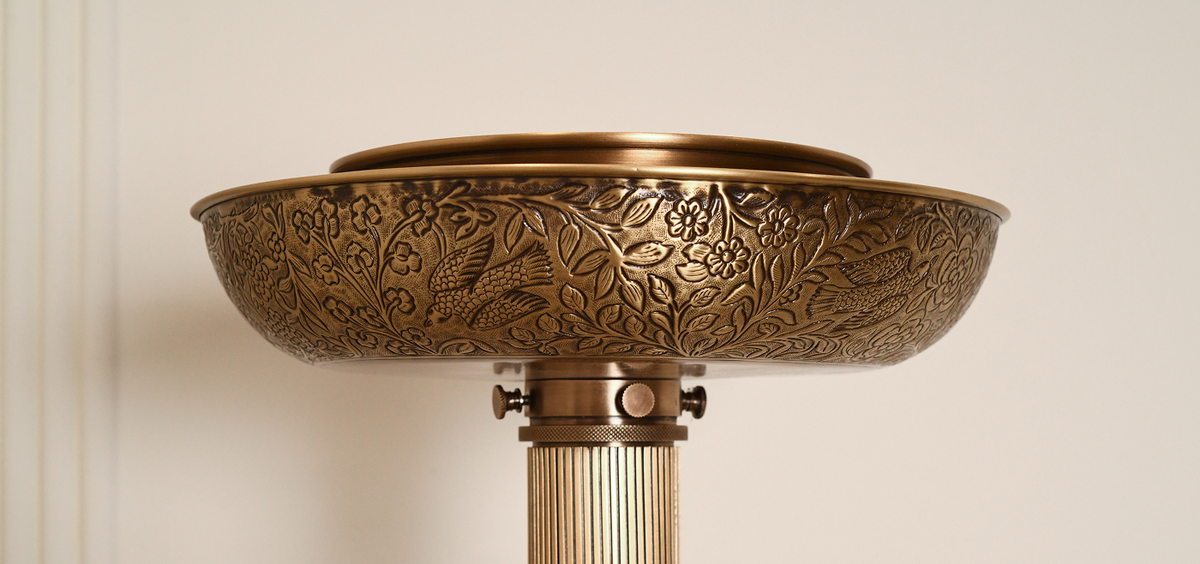
For repoussé, the sheet is set into a bed of pitch and worked from the reverse with punches so the design rises on the front. The detail is then sharpened from the front with chasing tools. This is how the Flying Cranes panel and the Twin Fish vase get their depth.
Step three: welding and dressing the seams
Most products are made from more than one part: a cup, a stem, a base. Those parts are TIG-welded, brazed or silver-soldered depending on the joint and the load it carries. The seam is then filed, sanded and dressed until the weld line disappears under the finish. This is where experience shows most. A poorly dressed weld telegraphs through a polished surface and weakens the piece over time.

Candle holder bases, stems and cups laid out before welding and assembly.
Step four: finishing
Finishing decides how a piece looks on day one and how it ages over twenty years. Brass can be polished to a mirror, brushed to a soft satin, burnished to a deeper and more mellow tone, or given an antique finish that darkens the recesses and lets the highlights glow. Some pieces are lacquered to slow tarnish. Others are left bare to develop their own patina. Our brass finish guide and lacquered vs unlacquered guide explain the choices.

Brass pieces, buffing wheels and work gloves in the workshop.
The tools behind the craft
A brass artisan works with a surprisingly small kit: planishing and raising hammers in several weights, stakes and mandrels, punches and chasing tools, files, abrasives and polishing wheels. None of it is complicated. What makes the difference is the hand holding it and the years behind that hand. In a family workshop those skills pass from person to person, and everyone shares the same quiet standard for what counts as finished.

Why some pieces take longer
Time follows detail. A plain cone vase can be formed and finished in a fraction of the time of a panel layered with birds, leaves and texture, where every square inch has to be worked, checked and refined. The Tree of Life panel is a piece where you can see the hours. Rushing the finish is the fastest way to ruin good shaping, so we plan for it from the start.
Why this matters more now
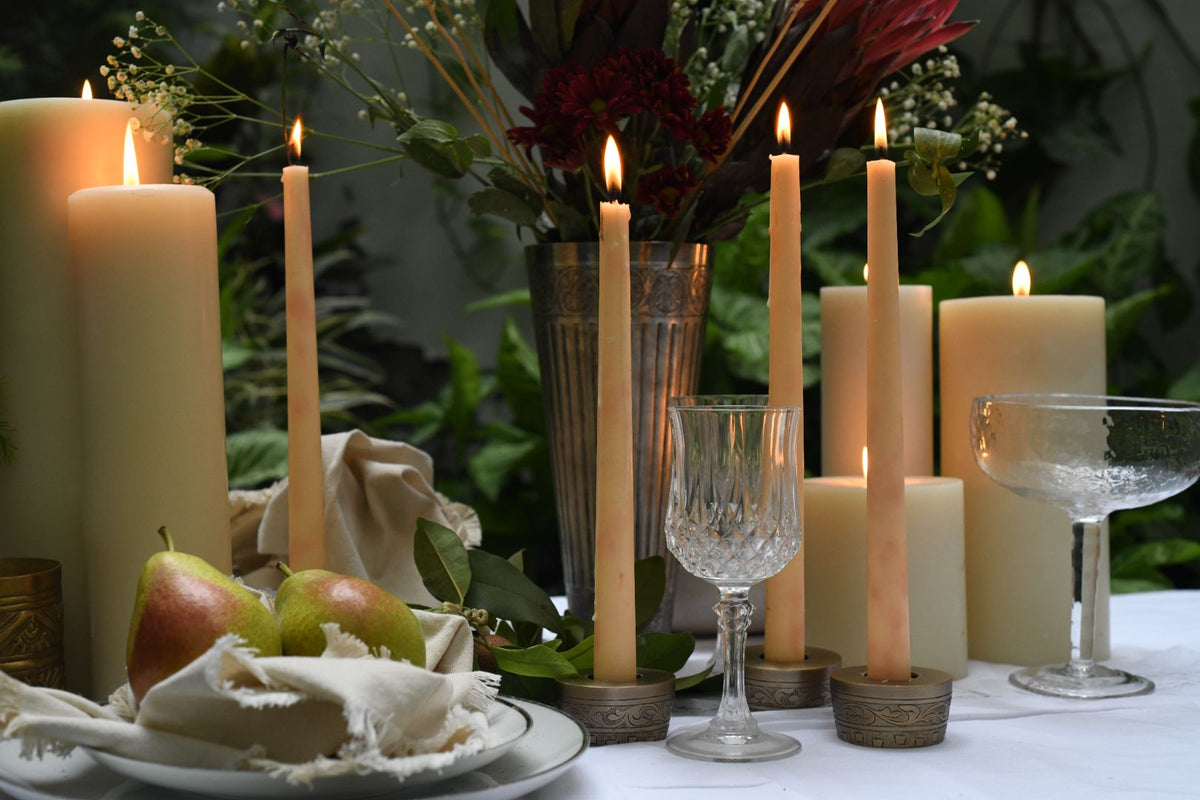
Foresight Factory's research on consumers in 2027 describes shoppers who swing back and forth between authentic and inauthentic options because it has become so hard to tell them apart. Hand work is the most honest answer I know to that confusion. You can see it, feel it and trust it. A hand-beaten holder is also something you will not need to replace, which means you can buy fewer and change the mood with what goes in it: a jewel-toned taper in winter, a ribbon at the stem for a celebration.
How to tell hand work from machine work
Look at the surface in raking light, with a lamp held low to one side. Hand-worked brass shows soft, slightly irregular planishing marks and small differences between two pieces of the same design. Spun or stamped brass is smoother and perfectly uniform. Neither is wrong, but only the first tells you a person shaped it.
Then turn it over. Careful makers finish the places you are not supposed to look, because a piece is judged by its worst detail. If the underside is as clean as the top, you are holding good work.
Step five: inspection before it leaves
Every piece is checked before it is packed. We look at finish consistency, weld strength, base stability and the overall form against the original drawing. Candle holders are tested with a standard taper. Vases are checked for balance and, where relevant, water tightness. Our guide to quality control explains what good inspection looks like with any maker.
To see the result, browse the candle holders and vases. The Serpentine taper holder is a good example of clean shaping and finishing at a small scale.
Frequently Asked Questions
Is hand-beaten brass better than machine-made brass?
Not in every case. Hand work gives depth, texture and character that machines struggle to copy, which suits decorative pieces and heirlooms. Machine work gives speed and uniformity, which suits simple repeated forms. Good workshops use both.
Why do handmade brass pieces look slightly different from each other?
Because a person shaped each one. Small variations in hammer marks and curves are cosmetic, not structural. Dimensions such as cup diameter and base footprint are still controlled.
How long does a repoussé piece take?
It depends on size and detail. A small trivet takes hours. A large panel with a full scene can take days of work.
How do I care for hand-finished brass?
Dust with a soft cloth and clean gently with mild soap and warm water. Avoid harsh abrasives. Our guide to cleaning brass candle holders has the full method.
Can you make hand-beaten pieces to my design?
Yes. We take custom briefs from brands and designers. Read about our product development process.
Pieces mentioned in this article
 Flying Cranes Repoussé Solid Brass Wall Art Panel
 Twin Fish Repoussé Burnished Brass Vase
 Tree of Life Repoussé Solid Brass Wall Art Panel
 Serpentine Burnished Brass Taper Candle Holder
About the author
Bhavini Khullar is the founder and creative director of Byaas and an adjunct professor of Advertising Media Strategies at Montclair State University. She grew up in her family's metal workshop and has spent more than a decade studying audiences and how people decide what to buy. Byaas is where those two worlds meet.
Live with fewer, better things
Every Byaas piece is made to be kept, restyled and handed down. Explore the collection.
For retailers, designers and brands: we supply boutiques through our trade program and make custom pieces for brands. Open a trade account or start a custom project.

Written by Bhavini Khullar